
Hot Dogs for Babies: How to Serve Them Safely
Key Takeaways
- Hot dogs are one of the highest-risk choking foods for young children: the cylindrical, compressible shape closely matches a small child's airway. The American Academy of Pediatrics (AAP) keeps them on its high-risk list until at least age 4, and older depending on development and maturity.
- Unlike popcorn, changing the shape of a hot dog lowers the risk substantially, though never to zero: quarter it lengthwise, then cut the strips no larger than half an inch. Never serve it as a coin, a shape no authority endorses for young children at any age.
- The CDC lists processed meats among the foods to limit for babies and toddlers because of sodium.
- Hot dogs are sold fully cooked but can still carry listeria. USDA advises people at higher risk of foodborne illness to reheat them until steaming hot, and young children qualify.
- The AAP recommends every caregiver take a certified infant and child CPR and first-aid course.
Why the Shape Is the Whole Problem
A young child's airway is roughly the diameter of a drinking straw. A standard hot dog is close to that same diameter. That single fact is why hot dogs appear on every pediatric choking hazard list.
Sliced into a coin, a hot dog becomes a smooth round plug of almost exactly the wrong size. It is also compressible, the part parents rarely hear. A hard object often lets some air past. A hot dog slice deforms on the way down, wedges, then springs back and seals the space completely.
The AAP's choking prevention policy statement has cited national data in which hot dogs accounted for a substantial share of food-related choking deaths. The guidance follows: keep firm round foods away from children until at least age 4, and older depending on development and maturity, and cut food no larger than half an inch.
Popcorn has no cut that helps at all. A hot dog does: the hazard lives in the shape, and the shape is under your control. That lowers the risk. It does not make a hot dog safe.
How to Cut a Hot Dog So It Is Not a Coin
Five steps, every single time:
- Choose skinless. If the hot dog has a natural casing, peel it off first: that skin resists a small child's bite and can come away as an intact ring.
- Cook or reheat until steaming hot (more on why below), then cool.
- Slice in half lengthwise, end to end.
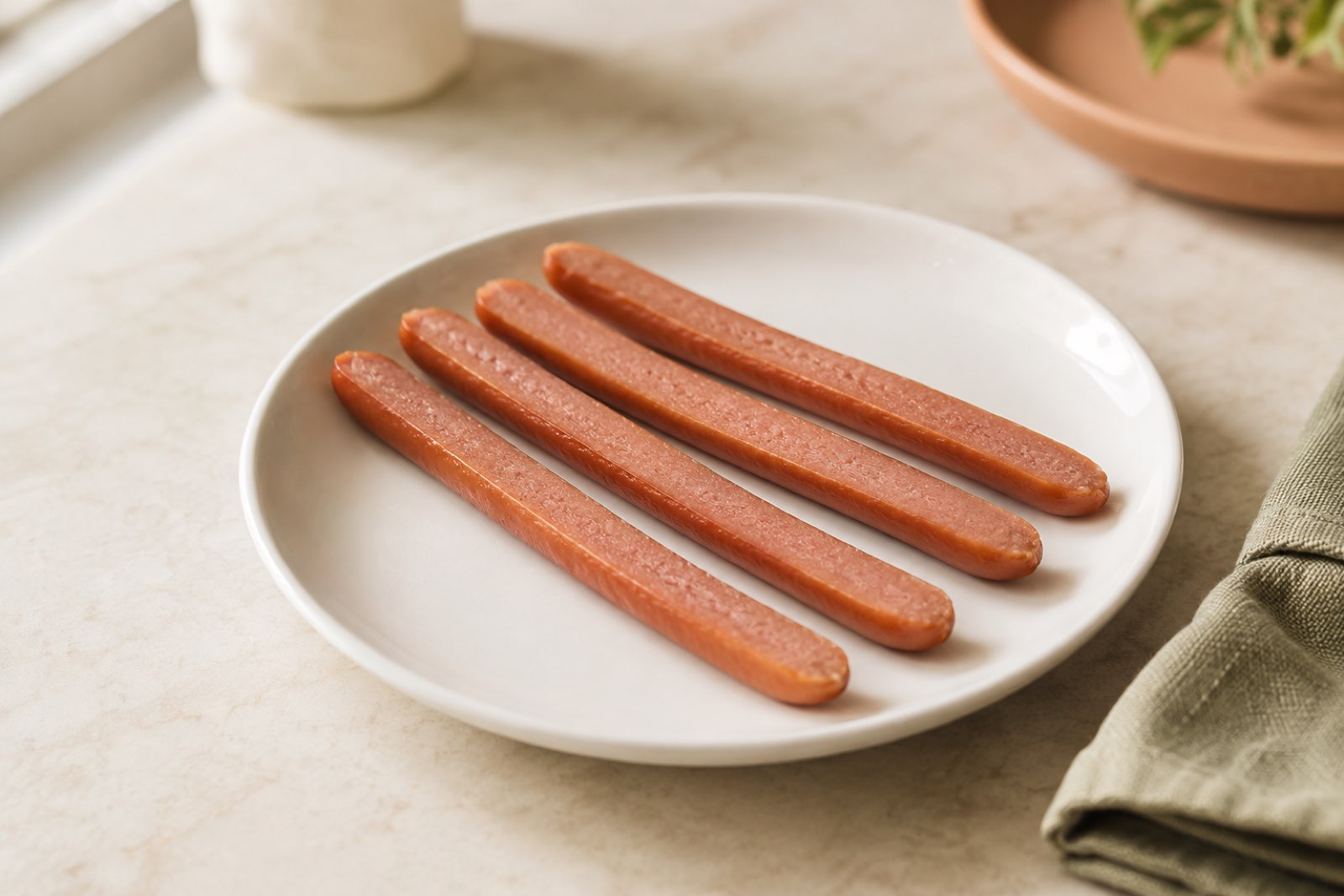
- Lay each half flat and slice lengthwise again, giving you four long thin strips.
- Cut those strips crosswise into pieces no larger than half an inch.
The result should look like short thin batons, not discs. Nothing on the plate should be round.
| Cut | What it looks like | Under 4? |
|---|---|---|
| Whole hot dog | Full cylinder | No |
| Coins or rounds | Airway-sized discs | No |
| Halved coins (half-moons) | Still thick and rounded | No |
| Quartered lengthwise, then chopped | Short thin strips | Lowest risk, seated and supervised |
Why Lengthwise Beats Crosswise
Cutting crosswise preserves the diameter, giving you smaller versions of the shape you want to eliminate. Cutting lengthwise removes the round, airway-sized cross-section that makes a coin so dangerous. It lowers the risk substantially without making a hot dog risk-free, which is why the half-inch rule and seated, supervised eating still apply.
Our safe cutting techniques guide covers the cuts food by food, and choking hazards under 4 covers foods with no safe version at all.
Age by Age
No agency sets an age at which hot dogs become approved. What exists is the AAP's choking guidance plus CDC guidance on sodium and processed meats.
| Age | Guidance |
|---|---|
| 6 to 9 months | Not recommended. Sodium is high for a baby's needs and chewing is still developing. Choose iron-rich, low-sodium first foods. |
| 9 to 12 months | Not recommended. The CDC lists hot dogs as both a choking hazard and a high-sodium processed meat to limit at this age, and one can exceed a full day's adequate sodium intake. Offer soft shredded chicken, moistened ground meat, or mashed beans instead. |
| 12 to 24 months | Occasional food. Always quartered lengthwise, then cut small. Watch the day's total sodium. |
| 2 to 4 years | Occasional food. Still quartered lengthwise and cut small. Hot dogs stay on the AAP high-risk list across this whole window. |
| 4 years and up | Risk falls as the airway grows and chewing matures, but no authority endorses whole or coin-cut hot dogs at any age. Many families keep the lengthwise cut well past 4. Judge by your child's chewing, not the birthday. |
Our texture progression guide maps the stages. The answer changes food by food, though, and you usually need it ninety seconds before dinner. TinyPlate's Safety Search is built for that: type in a food, set your child's age, get the cut and stage guidance. Get TinyPlate on the App Store.
Supervision, Cookouts, and Real Life
Cutting correctly lowers the odds. It does not remove them. The rest of the protection is how the meal is run.
- Sit with your child, within arm's reach, for the whole meal. Never leave a young child alone with food.
- Keep them upright in a high chair or at the table. Not in a car seat, not in a stroller, not in a moving vehicle. The CDC advises against eating while moving.
- No running, playing, or talking with food in the mouth, and no hot dog carried around the yard.
- Take a certified infant and child CPR and first-aid course. The AAP recommends it for every caregiver, and the American Red Cross and American Heart Association teach them locally. Make sure grandparents and sitters know what a silent choke looks like: no sound, no cough, no air moving.
The riskiest hot dog is rarely the one you prepared. It is the one handed to your child at a barbecue, already sliced into coins by someone being helpful. Cut the portion yourself, and tell caregivers once, clearly. This rule gets forgotten, not refused.
If hot dogs feel like more trouble than they are worth, good stand-ins are soft shredded chicken, ground beef or turkey moistened with sauce or broth so it does not clump, beans mashed flat (whole beans are round and stay a hazard under 4, like cheese cubes), and vegetables cooked soft enough to squash between finger and thumb. Our iron-rich first foods guide has options that do more nutritional work.
Sodium, Nitrates, and What "Uncured" Means
The Dietary Reference Intakes set an Adequate Intake for sodium of 370 mg per day for infants 7 to 12 months and 800 mg for children 1 to 3 years. One standard hot dog typically contains several hundred milligrams, so for a baby under 1 it can meet a full day's intake by itself. The CDC names lunch meats, sausages, hot dogs, and ham as processed meats to limit for exactly this reason.
Curing salts are the other reason to keep these occasional. The World Health Organization's International Agency for Research on Cancer classified processed meat as carcinogenic in 2015, a rating about the strength of the evidence, not the risk from one meal.
"Uncured" does not mean nitrite-free. Under USDA rules, a hot dog cured with celery powder is still labeled "uncured," with fine print reading "no nitrates or nitrites added except those naturally occurring in celery powder." The nitrite does the same work. Your lever is frequency and portion size, not the front of the package.
Hot dogs also frequently contain milk, soy, or wheat as binders, so check the ingredient list if your child has a known allergy or has not yet been introduced to those foods. Our guide to reading food labels applies the same skill to allergens.
Always Reheat Until Steaming
Hot dogs are sold fully cooked, so a lot of people serve them cold. For young children, do not.
Listeria monocytogenes can contaminate ready-to-eat foods like hot dogs and deli meats after cooking, and unlike most bacteria it grows slowly even at refrigerator temperatures. Refrigeration does not stop it. Reheating does. USDA and CDC guidance for people at higher risk of foodborne illness is to reheat hot dogs to an internal 165°F, or until steaming hot, just before serving. Young children have immature immune systems, so make it a household rule.
Then handle the heat. Microwaved hot dogs cook unevenly and hold steam pockets, so an outside that feels warm can hide a core hot enough to burn a toddler's mouth. Cut a piece open, let it cool, then test from the inside before it reaches the plate. Once a package is opened, use it within about a week.
What This Comes Down To
Hot dogs are not banned food. They are shape-dependent food.
Served as coins, they are one of the most dangerous things you can put in front of a young child. Quartered lengthwise and cut no bigger than half an inch, they become a reasonable occasional meal. Reheat until steaming, keep portions small, stay within arm's reach, and keep the lengthwise cut until at least age 4, longer if your child's chewing says so.
That is the whole rule, and it takes about fifteen extra seconds with a knife. For the same judgment on every other food on the table, download TinyPlate on the App Store.
Sources
- American Academy of Pediatrics. "Choking Prevention." HealthyChildren.org.
- American Academy of Pediatrics. "Policy Statement: Prevention of Choking Among Children." Pediatrics.
- CDC. "Foods and Drinks to Avoid or Limit," Infant and Toddler Nutrition.
- CDC. "Preventing Listeria Infection" and "People at Risk for Listeria Infection."
- USDA Food Safety and Inspection Service. "Hot Dogs and Food Safety."
- National Academies of Sciences, Engineering, and Medicine. "Dietary Reference Intakes for Sodium and Potassium."
- World Health Organization, International Agency for Research on Cancer. "Carcinogenicity of the Consumption of Red Meat and Processed Meat," 2015.