
Texture Progression: From Smooth Purees to Family Foods
Key Takeaways
- Babies move through three to four distinct stages of baby food textures between 6 and 12 months.
- Staying on smooth purees past 8 to 9 months is associated with more difficulty accepting lumpy and solid foods later.
- Texture progression is about exposure, not perfection. A baby who is comfortable with lumps at 8 months is on track.
- Gagging is normal during texture transitions and is not the same as choking.
- A baby who refuses lumpy foods is usually telling you they need more exposure, not less.
Why Texture Progression Matters
In the starting-solids stage, parents tend to focus on which foods to introduce. What gets less attention, and matters just as much, is the texture of those foods. A 6-month-old eating smooth puree is doing exactly what they should be. A 10-month-old still on the same smooth puree has missed several windows of motor and sensory development that are easier to navigate at the right age than to catch up on later.
Texture progression is not just about chewing. It is about training the oral-motor system (tongue lateralization, jaw movement, soft palate control) and the sensory system (tolerating new mouth-feels without gagging or refusing) for the foods your child will eat for the rest of their life.
The good news: most babies move through the stages naturally with regular exposure. The skill is on the parent side, knowing when to push texture forward.
Stage 1: Smooth Purees (Around 6 Months)
What it looks like: Single-ingredient purees with no lumps, the consistency of a thin milkshake or a yogurt drink. Easily moved off a spoon with the tongue.
Examples: Iron-fortified infant cereal mixed with breast milk or formula. Pureed sweet potato thinned to ribbon consistency. Smooth mashed avocado.
Why this stage matters: At 6 months, most babies are just losing the tongue-thrust reflex. A smooth, thin texture lets them learn the basics of swallowing food (as opposed to swallowing milk) without managing complexity.
How long it lasts: Usually 2 to 4 weeks. Some babies move through stage 1 in a few days.
Stage 2: Thicker Purees and Soft Mash (Around 7 to 8 Months)
What it looks like: Thicker, more cohesive purees with some texture. Soft mashes that hold a shape on the spoon. Small, soft lumps mixed into smooth bases.
Examples: Mashed banana with some texture left in. Lentil mash with a slightly chunky consistency. Smashed cooked peas. Yogurt with a few tiny pieces of soft fruit folded in. Soft, well-cooked oatmeal.
Why this stage matters: This is where your baby learns that food can have variation. The tongue practices moving food around the mouth, not just pushing it back to swallow. The first soft lumps train the muscles that will eventually handle table food.
A common mistake at this stage is moving back to smooth purees because the baby gags on a lump. Some gagging is expected. Gagging is a protective reflex, not a sign of choking, and it usually self-resolves within a few seconds. (More on this below.)
How long it lasts: Usually 4 to 8 weeks, blending into stage 3 over time.
Stage 3: Soft Minced and Mashed Foods (Around 8 to 10 Months)
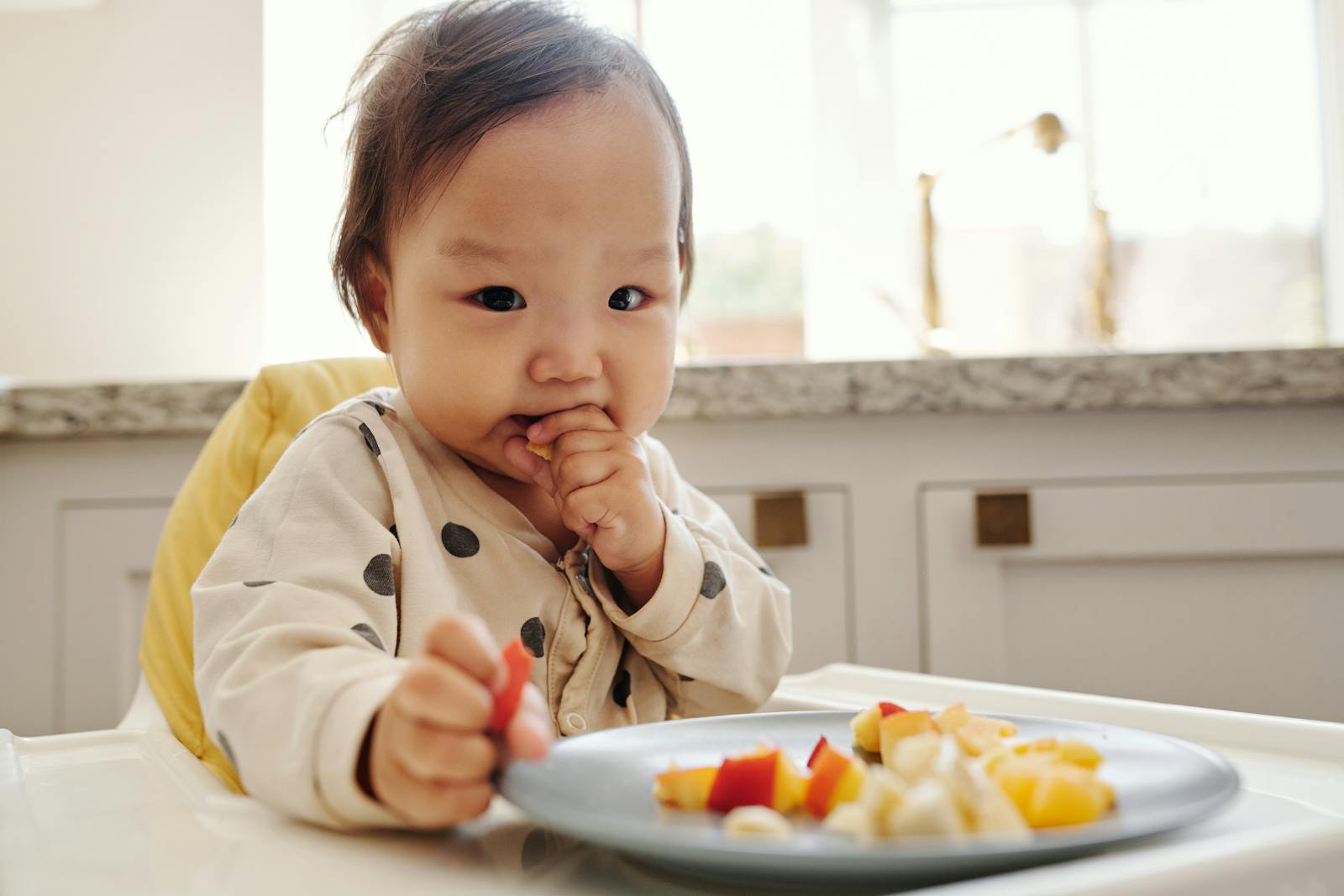
What it looks like: Soft foods that have been minced, mashed, or shredded into small, easily managed pieces. Recognizable textures rather than blended ones. Soft finger foods that the baby can pick up and gum.
Examples: Soft shredded chicken in a small portion. Well-cooked pasta cut into bite-sized pieces. Cubed soft sweet potato. Mashed beans that hold a shape. Banana cut into small rounds (still soft enough to squish between your fingers). Small fluffy scrambled egg pieces.
Why this stage matters: Stage 3 is the big motor-skill leap. The baby learns to chew (even with no teeth) by gumming food against the gums and the roof of the mouth. They learn to handle multiple textures in the same bite (a small piece of soft meat and a small piece of vegetable on the same spoon). They build the foundation for table food.
This is also when self-feeding really takes off, since the pieces are large enough to grasp but small enough to be safe.
How long it lasts: Usually 2 to 4 months, with table foods gradually replacing more and more of the meal.
Stage 4: Soft Table Foods (Around 10 to 12 Months)
What it looks like: Most of what the family eats, with modifications for salt, sugar, and choking hazards. Small soft pieces of meat, soft cooked vegetables, soft pasta, soft bread.
Examples: Soft pasta with a small amount of tomato sauce. Mini meatballs (well-cooked, no salt). Soft scrambled tofu. Pancake pieces. Shredded cheese or thin flat cheese strips. Quartered grapes. Soft fruit pieces.
Why this stage matters: By the first birthday, most babies are eating a modified version of family meals. The texture range is wide, the variety is broader, and the baby is approaching toddlerhood. The work of the first six months of solids was setting up this point.
Common modifications: Keep added salt minimal (under 1 g per day for babies under 12 months, per WHO guidance). Skip honey until 12 months due to botulism risk. Always quarter grapes and cherry tomatoes lengthwise through age 4; at 4+ still cut unless this child chews well.
Gagging Versus Choking
This is the single most important distinction in texture progression.
Gagging is loud, dramatic, and self-resolving. The baby coughs, sputters, or makes retching sounds. Their color stays normal. They can still cry or vocalize. The gag reflex is doing its job, moving food forward and away from the airway.
Choking is silent. The baby cannot cough, cry, or make sound. Their color may change (pale or bluish). This is a medical emergency.
The AAP is direct that gagging is a normal part of learning to eat textured foods, and that babies tend to gag more when textures advance. A baby who gags on a lump in week one of stage 2 is not signaling that they cannot handle it. They are signaling that they are learning. Continued exposure builds tolerance.
Take an infant CPR class before your baby starts solids. Knowing the difference under pressure is the difference.
What If Your Baby Refuses Lumpy Foods?
A baby who consistently gags or refuses lumpier textures past 9 to 10 months may need:
- More exposure, not less. Repeated tastings (8 to 15 times) are often needed before a baby accepts a new texture. Pulling back at the first refusal sends the wrong signal.
- Smaller texture jumps. If a baby is comfortable with smooth puree but refuses chunky mash, try a slightly thicker puree first.
- A pediatric speech-language pathologist or occupational therapist consult. If the issue persists past 12 months, an evaluation for feeding difficulties is worth a conversation with your pediatrician. Early intervention is highly effective.
What TinyPlate Does Differently
The Weekly Meal Plan inside TinyPlate adjusts texture stage automatically based on your child's age, so the recipes you see match where your baby is developmentally. As your child ages up, the plan advances texture without you tracking it manually. If you want to slow down (or speed up), you can adjust the stage in settings.
The Safety Search also flags texture-stage notes on every food. When you check whether a baby can eat almonds, the answer is not just yes or no, it is "yes, as smooth almond butter for 6 months and up. Whole almonds wait until 4 years."
Download TinyPlate free on the App Store.
Sources
- American Academy of Pediatrics. "Switching to Solid Foods." HealthyChildren.org, 2024.
- World Health Organization. "Complementary Feeding." WHO Nutrition Topics.
- Coulthard, H., et al. "Delayed Introduction of Lumpy Foods to Children During the Complementary Feeding Period Affects Child's Food Acceptance and Feeding at 7 Years of Age." Maternal and Child Nutrition, 2009.
- Centers for Disease Control and Prevention. "Foods and Drinks for 6 to 24 Month Olds." CDC Infant and Toddler Nutrition.
- Fewtrell, M., et al. "Complementary Feeding: A Position Paper by the ESPGHAN Committee on Nutrition." Journal of Pediatric Gastroenterology and Nutrition, 2017.