
Cheese for Babies: Safe Types and Portions
Key Takeaways
- Pasteurized cheese can start around 6 months, even though cow's milk as a drink waits until the first birthday.
- Skip unpasteurized (raw milk) cheese completely. The FDA and CDC link raw dairy to listeria, salmonella, and E. coli, and young children get sicker from these germs.
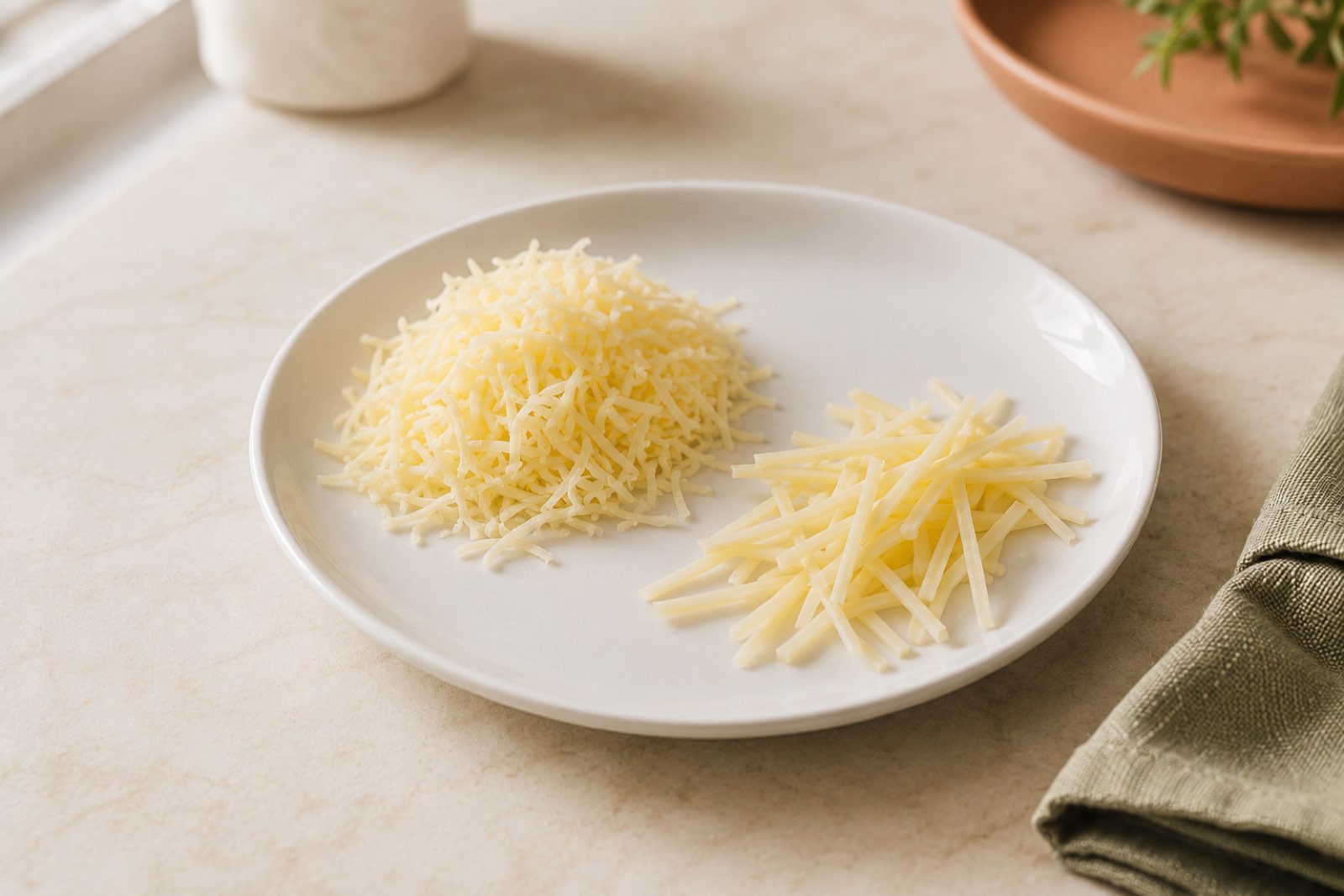
- Cheese cubes, coins, and whole cheese sticks are a real choking hazard. The AAP names chunks of cheese and string cheese among foods to keep from young children. Shred, melt, or cut thin flat strips.
- Watch sodium. Choose mild, lower-sodium cheeses like Swiss, fresh mozzarella, and ricotta over feta, parmesan, and processed slices.
- Cheese is an early milk-protein exposure, so it belongs in your allergen plan, introduced around 6 months rather than delayed.
When Can Babies Have Cheese?
Around 6 months, once your baby is showing the readiness signs for solids, pasteurized cheese is on the table. No rule says dairy waits until one year.
Cheese is a useful first food. It carries fat, protein, and calcium in a small volume, and makes vegetables and grains more appealing. Not all cheese is baby-appropriate.
Cheese Is Not the Same as a Cup of Milk
The USDA and the AAP advise against giving cow's milk as a drink before 12 months. The reason is not allergy. Cow's milk is low in iron, it can interfere with iron absorption, and in volume it displaces breast milk or formula. That is also why iron-rich first foods get so much attention.
Cheese and yogurt are different. They are eaten in small amounts as food, not by the cupful, so they do not crowd out milk feeds. The USDA is explicit that both can be introduced before 12 months.
Pasteurized vs Unpasteurized: The One Non-Negotiable
Pasteurization heats milk enough to kill harmful bacteria without meaningfully changing its nutrition. Unpasteurized cheese skips that step.
The FDA and CDC both warn that raw milk products can carry listeria, salmonella, E. coli, and campylobacter, and that the risk falls hardest on young children. A joint FDA and Health Canada risk assessment found the per-serving listeriosis risk from soft-ripened cheese is far higher when it is made from unpasteurized milk.
How to check. Read the label and look for the word "pasteurized." If it says "raw milk" or "unpasteurized," put it back. Farmers market cheese, imported specialty cheese, and anything bought abroad are worth double-checking.
A second layer. Some cheeses hold moisture and can pick up contamination after pasteurization. The CDC advises people at higher risk of listeriosis to avoid unheated queso fresco style cheeses regardless of the milk used. For the first year:
| Cheese type | Under 12 months |
|---|---|
| Hard and semi-hard, pasteurized (Swiss, mild cheddar, Colby, Monterey Jack) | Yes, prepared safely |
| Fresh pasteurized (mozzarella, ricotta, cottage cheese, cream cheese, paneer) | Yes, prepared safely |
| Soft-ripened and mold-ripened (brie, camembert, blue-veined) | Skip under 12 months |
| Fresh Latin-style soft cheeses (queso fresco, queso blanco, panela) | Skip unless cooked until steaming hot |
| Anything unpasteurized or raw milk | No, at any age in early childhood |
Heat is what kills listeria. Heat cheese until steaming hot throughout, 165°F on a thermometer, then let it cool to warm before serving. Melted cheese holds heat far longer than the food around it.
The Shape Problem: Why Cheese Is a Choking Hazard
Cheese is soft, so it feels safe. But the shape is the problem, not the texture.
The AAP lists chunks of cheese and string cheese among the high-risk foods for young children. A cheese cube or a coin cut from a stick is firm, round, and almost exactly the diameter of a young child's airway, and because it compresses and grips it is hard to dislodge. It sits with hot dog coins, whole grapes, and whole nuts. The AAP recommends cutting food for young children into pieces no larger than one-half inch.
| Age | Safest ways to serve cheese |
|---|---|
| 6 to 9 months | Finely shredded into purees or scrambled egg. Melted thinly onto soft food. Ricotta or cottage cheese spread in a thin layer on soft toast, crusts removed. |
| 9 to 12 months | Finely shredded, or flat strips the length of an adult finger and no thicker than 1/4 inch. Flat and flexible, never round or chunky. Soft cheese spread thinly on toast or pasta. |
| 12 to 24 months | Thin flat pieces no larger than half an inch, never cube-shaped. String cheese pulled apart into thin strands, never bitten off the stick. |
| Any age under 4 | No cubes, no coins, no whole cheese sticks, no hard chunks. Firm round shapes stay off the plate until at least 4. |
Serve cheese only when your child can sit upright unsupported, in a high chair, with an adult within arm's reach for the whole feed. Never in a car seat, stroller, or while walking, crawling, or playing, and never leave a baby alone with food. Go easy on melty, sticky cheese pulls, which can form a wad. See our guides to choking hazards for children under 4 and safe cutting techniques.
Picking a Lower-Sodium Cheese
Cheese is one of the saltiest foods that regularly lands on a baby plate.
The National Academies set the recommended sodium intake for infants 7 to 12 months at 370 milligrams per day, a figure carried into the USDA Dietary Guidelines. The CDC advises against high-salt foods across the 6 to 24 month window, partly because early salt exposure shapes taste preferences that last.
Using USDA nutrient data as a rough guide, Using USDA nutrient data as a rough guide, Swiss lands around 50 milligrams of sodium per ounce, cheddar closer to 180, feta around 320, and grated parmesan around 500. One ounce of a salty cheese can be a large share of a day's total.
Lower-sodium picks for babies: pasteurized Swiss and Emmental, fresh mozzarella, whole-milk ricotta, paneer, and cream cheese.
Save for later or use sparingly: feta, parmesan, halloumi, blue cheese, processed American slices, cheese spreads, and most cheese-flavored crackers and puffs.
Regular cottage cheese is saltier than it looks, so pick a no-salt-added tub for babies. A teaspoon of parmesan stirred through a whole bowl of pasta is a very different sodium load from an ounce on its own.
How Much Cheese by Age
These are practical amounts, not hard limits.
| Age | Typical daily cheese |
|---|---|
| 6 to 9 months | A tablespoon or so of shredded or soft cheese a few times a week, worked into other foods |
| 9 to 12 months | About half an ounce on a day it is served, up to an ounce if it is a low-sodium cheese like Swiss or fresh mozzarella |
| 12 to 24 months | USDA's 2020-2025 Dietary Guidelines counted 1.5 ounces of hard cheese or 1/3 cup shredded as one cup-equivalent, and suggested roughly 1 2/3 to 2 cup-equivalents of dairy daily across milk, yogurt, and cheese |
The AAP's sample one-day menu for an 8 to 12 month old includes cheese as one snack option. Serve it shredded or in thin strips rather than in chunks, since the AAP lists chunks of cheese as a choking hazard. If cheese shows up at every meal, it is probably crowding out iron-rich foods and vegetables.
Unsure whether a specific cheese works for your baby's age? TinyPlate's Safety Search gives the answer and the safe cut for their stage. Check any food by age in TinyPlate.
Cheese and Milk Allergy
Milk is one of the nine major allergens, and cow's milk allergy is the most common food allergy in early childhood. Cheese is a milk protein exposure, so it belongs in your allergen plan.
Guidance from the AAAAI and NIAID does not support delaying allergenic foods to prevent allergy. For most babies, introduce allergens in a safe form around 6 months, once a few simple foods are already tolerated, and never before 4 months. Where your baby sits changes the plan:
- Higher risk (severe eczema or an existing egg allergy): talk to an allergist first. Guidance supports earlier introduction, roughly 4 to 6 months, after that conversation.
- Moderate risk (mild to moderate eczema): check in with your pediatrician, then introduce around 6 months.
- Lower risk: around 6 months at home.
Offer a new cheese at home, earlier in the day, on its own rather than alongside three other new foods. Once it is tolerated, keep milk protein in the rotation about 2 to 3 times per week.
Mild reactions like a few hives or a single vomit warrant a call to your pediatrician. Any trouble breathing, wheezing, swelling of the lips, tongue, or face, repeated vomiting, pale or floppy behavior, or collapse is a medical emergency. If your child has been prescribed epinephrine, give it right away in the outer thigh, then call 911. If not, call 911 immediately. Do not drive to the office, and do not wait to see if it passes.
Our guide to the top 9 allergens walks through the full approach. Tracking what you introduced and when is hard on broken sleep, so TinyPlate's Allergen Tracker logs each exposure and reaction for your pediatrician.
The Short Version
The rules are simpler than they sound. Pasteurized only. Mild and lower in sodium. Shredded, melted, or thin flat strips, never cubes or coins. Small amounts alongside iron-rich foods.
Get TinyPlate on the App Store to check any food by age and keep the allergen log in one place.
Sources
- U.S. Food and Drug Administration. "The Dangers of Raw Milk." FDA.gov.
- FDA and Health Canada. "Joint Quantitative Assessment of the Risk of Listeriosis from Soft-Ripened Cheese Consumption."
- Centers for Disease Control and Prevention. "Listeria and Food" and "Infant and Toddler Nutrition."
- American Academy of Pediatrics. "Choking Prevention" and "Sample Menu for an 8 to 12 Month Old."
- U.S. Department of Agriculture. "Dietary Guidelines for Americans, 2020-2025" and FoodData Central.
- American Academy of Allergy, Asthma & Immunology. "Prevention of Allergies and Asthma in Children."
- National Institute of Allergy and Infectious Diseases. "Guidelines for the Diagnosis and Management of Food Allergy."