
Bananas for Babies: A First-Food Guide
Key Takeaways
- Offer banana once your baby is ready for solids, which the AAP places at around 6 months.
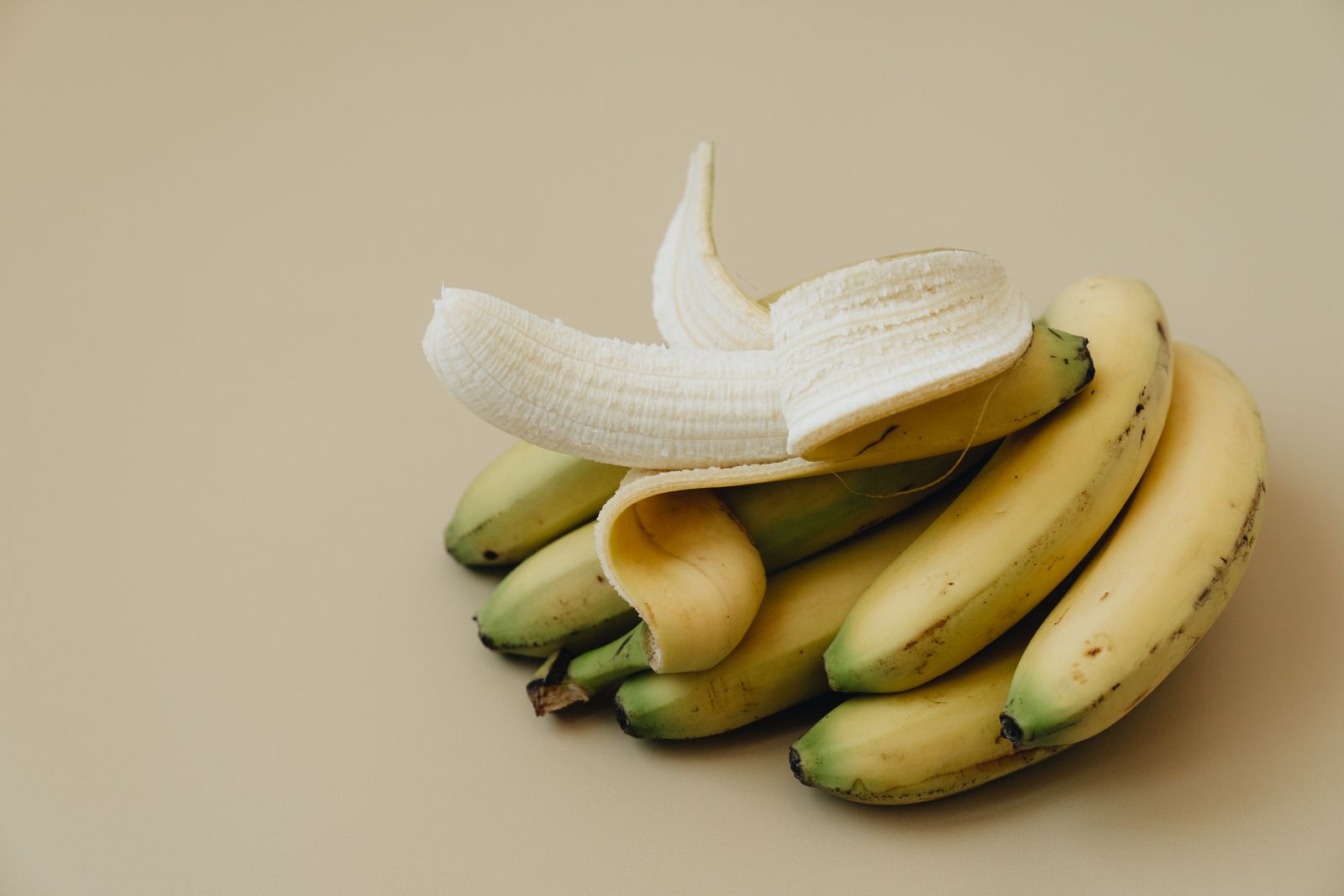
- For baby-led weaning, peel a ripe banana halfway down, leave the lower peel on as a grip, and cut the exposed half lengthwise into a spear.
- Ripe banana with brown speckles is softer and easier to gum than a firm green one.
- Ripe banana does not reliably cause constipation. For that, the AAP points to prunes, pears, and plums.
- Banana has almost no iron, so pair it with an iron-rich food rather than serving it in place of one.
When Can Babies Have Banana?
Banana needs no cooking, mashes with a fork, and comes in its own wrapper. Per USDA FoodData Central it also brings potassium, vitamin B6, and a little vitamin C.
The AAP recommends starting solids at around 6 months, when your baby can hold their head steady, sit upright with support, open their mouth for a spoon, and move food to the back of the mouth to swallow. Those signs matter more than the calendar, and our guide to readiness signs for starting solids walks through each one.
There is no required order. The AAP recommends one new single-ingredient food from any food group every 3 to 5 days, so banana can be first or fifteenth.
Banana by Age
| Age | How to serve | Amount to start |
|---|---|---|
| 6 to 8 months | A finger-length spear with the lower peel left on as a grip, or mashed smooth and thinned with breast milk or formula | The CDC suggests starting solids at 1 to 2 tablespoons |
| 9 to 11 months | Cut the banana in half lengthwise, down the long axis, for two flat-sided halves, then cut across into short pieces. Do not serve full round coins. Pea-sized pieces once the pincer grasp appears | A few tablespoons alongside other foods |
| 12 to 24 months | Bite-sized pieces, following AAP guidance to keep pieces no larger than half an inch | Roughly half a banana, adjusted to appetite |
Banana is soft and collapses under light pressure, so it does not carry the same risk profile as firm round foods like whole grapes (which should always be quartered lengthwise, never whole or as round halves). See our guide to safe cutting techniques.
Every stage needs the same non-negotiables from the AAP: your baby sits fully upright in a high chair, stays seated for the whole meal, and is watched the entire time. No eating in a car seat, stroller, or while reclined, crawling, walking, or playing.
For any food not on this page, TinyPlate's Safety Search gives the age-banded answer in seconds. Get TinyPlate on the App Store.
The Baby-Led Weaning Banana Spear
A peeled banana is slippery, and a 6-month-old with a raking grasp will squeeze it into pulp. The peel is the fix.
- Wash the banana under running water first. The FDA recommends rinsing produce even when you plan to peel it, because a knife can carry bacteria from the skin into the flesh.
- Peel down about halfway, leaving the bottom half of the peel intact.
- Cut the exposed piece in half lengthwise so your baby holds a flat-sided spear, not a fat cylinder.
- Hand it over peel-end down. The peel gives grip, and the soft top is what your baby gums.
Do not let your baby bite or mouth the peel. Peel is tough and does not break down, and a torn piece is a choking hazard. Take the banana back as soon as your baby reaches the peel, and check their mouth for fragments. If the peel grip is not working, serve mashed banana or a spear rolled in infant oatmeal instead.
Ripeness Changes Almost Everything
Green or underripe bananas are high in resistant starch, which makes them firmer, more astringent, and harder for a young baby to gum. Ripe bananas, speckled brown across the peel, have converted much of that starch to simple sugars, so they mash easily. Overripe is fine for mashing, just too loose to hold as a spear.
Aim for well-speckled. If the banana snaps when you break it, give it another day.
The Constipation Question, Answered Honestly
The worry has a real origin: underripe bananas are high in resistant starch and tannins, which can slow things down. For a ripe banana, the evidence is thin. The AAP's constipation guidance names high-fiber foods to add rather than foods to avoid, and banana is not flagged as a cause. Most infant constipation traces elsewhere: a change in milk, the move to solids, low fluid intake, or a diet heavy in low-fiber starches.
If your baby is constipated, the AAP suggests higher-fiber fruits and vegetables such as prunes, pears, plums, peaches, apricots, peas, and beans. Talk to your pediatrician before using any juice or remedy in the first year, and call if it persists or your baby seems in pain. Banana is not the villain, and it is not the fix.
Banana Is Not an Iron Food
Full-term babies are born with iron stores that typically last about 4 to 6 months, per the NIH Office of Dietary Supplements. After that, iron comes from food, and the NIH sets the intake for babies 7 to 12 months at 11 mg per day. The AAP also recommends supplemental iron, about 1 mg per kg per day, for exclusively or partially breastfed infants from around 4 months until iron-rich foods are established, so ask your pediatrician about iron and vitamin D.
Banana contributes almost none of it. Per USDA data, raw banana has roughly 0.3 mg of iron per 100 grams, a rounding error against 11 mg.
| Pair banana with | Why it works, and how to serve it |
|---|---|
| Iron-fortified infant cereal | A reliable iron source named by the CDC and AAP; mashed banana makes it palatable without added sugar |
| Meat, cooked through | Heme iron, the form the CDC notes is most readily absorbed. Cook to USDA safe internal temperatures, 165F for poultry and 160F for ground meat, then puree or finely mince and moisten it. Skip long shreds, which are stringy and hard to gum |
| Lentils, beans, or tofu | Plant iron. Smash or flatten every bean and lentil first, since intact skins are a choking risk. Serve tofu in soft strips |
| Thinned smooth peanut or other nut butter | Protein and fat, plus early allergen exposure. Thin it to a spreadable consistency. Never a spoonful, blob, or spread on a cracker, and no whole or chopped tree nuts under 4 |
On peanut timing: for most babies, introduce allergens in a safe form around 6 months, once a few simple foods are tolerated, and never before 4 months. With mild to moderate eczema, check in with your pediatrician and still aim for around 6 months. If your baby has severe eczema, an existing egg allergy, or both, NIAID recommends an allergist evaluation before peanut is offered at home, which may include peanut-specific IgE or a skin prick test and possibly a supervised first feeding; earlier introduction, roughly 4 to 6 months, may be advised. Once tolerated, keep the allergen in rotation about 2 to 3 times per week. Our peanut butter guide has the full method.
The vitamin C in banana helps the body absorb non-heme iron from plants, which the NIH notes is absorbed far less efficiently than heme iron. Banana supplies only a modest amount, about 9 mg per 100 grams per USDA. Strawberry or bell pepper do more. See our guide to iron-rich first foods.
Allergy and Forms to Skip
Banana is not one of the nine major allergens the FDA requires to be labeled, and true banana allergy is uncommon. It does appear with latex allergy, where banana, avocado, kiwi, and chestnut most often cross-react. If latex allergy runs in your family, mention banana to your pediatrician first. Our top 9 allergens guide covers the fuller framework.
A few banana products are not banana:
- Banana chips are hard, dry, and usually fried, the same category as popcorn: hard foods to keep away from children under 4.
- Banana with honey is not safe under 12 months. Honey carries a risk of infant botulism, and both the CDC and AAP advise no honey in the first year.
- Sweetened banana yogurts, puddings, and pouches often carry added sugar, which the 2025-2030 Dietary Guidelines for Americans advise avoiding from birth through age 4.
Where Banana Actually Fits
Serve it ripe, use the peel-gripped spear for baby-led weaning, and stop worrying about constipation unless your baby is actually constipated. Banana is a side, not a center. Pair it with iron and it earns its place on the tray. If you want a week already built that way, TinyPlate's AI meal plan does it for you. See TinyPlate on the App Store.
Related reading
- Starting solids: readiness signs to look for
- Iron-rich first foods for babies
- Safe cutting techniques for common choking hazards
Sources
- American Academy of Pediatrics. "Starting Solid Foods." HealthyChildren.org.
- American Academy of Pediatrics. "Choking Prevention." HealthyChildren.org.
- American Academy of Pediatrics. "How Can I Tell If My Baby Is Constipated?" HealthyChildren.org.
- Centers for Disease Control and Prevention. "Foods and Drinks for 6 to 24 Month Olds." CDC Infant and Toddler Nutrition.
- Centers for Disease Control and Prevention. "Iron." CDC Infant and Toddler Nutrition.
- National Institutes of Health, Office of Dietary Supplements. "Iron: Fact Sheet for Health Professionals."
- National Institute of Allergy and Infectious Diseases. "Addendum Guidelines for the Prevention of Peanut Allergy in the United States."
- U.S. Department of Agriculture. "Bananas, raw." FoodData Central.
- U.S. Department of Agriculture. "Safe Minimum Internal Temperature Chart." Food Safety and Inspection Service.
- U.S. Department of Agriculture. "Dietary Guidelines for Americans, Birth to 24 Months," 2020 to 2025.
- U.S. Food and Drug Administration. "Selecting and Serving Produce Safely."