
Tree Nuts for Babies: Never Whole
Key Takeaways
- Whole tree nuts are not safe under age 4. The American Academy of Pediatrics (AAP) advises waiting until a child chews reliably. Firm round foods that hold their shape belong in the same group.
- Delaying allergens does not prevent allergy. For most babies, introduce them in a safe form around 6 months, once a few simple foods are tolerated, and never before 4 months.
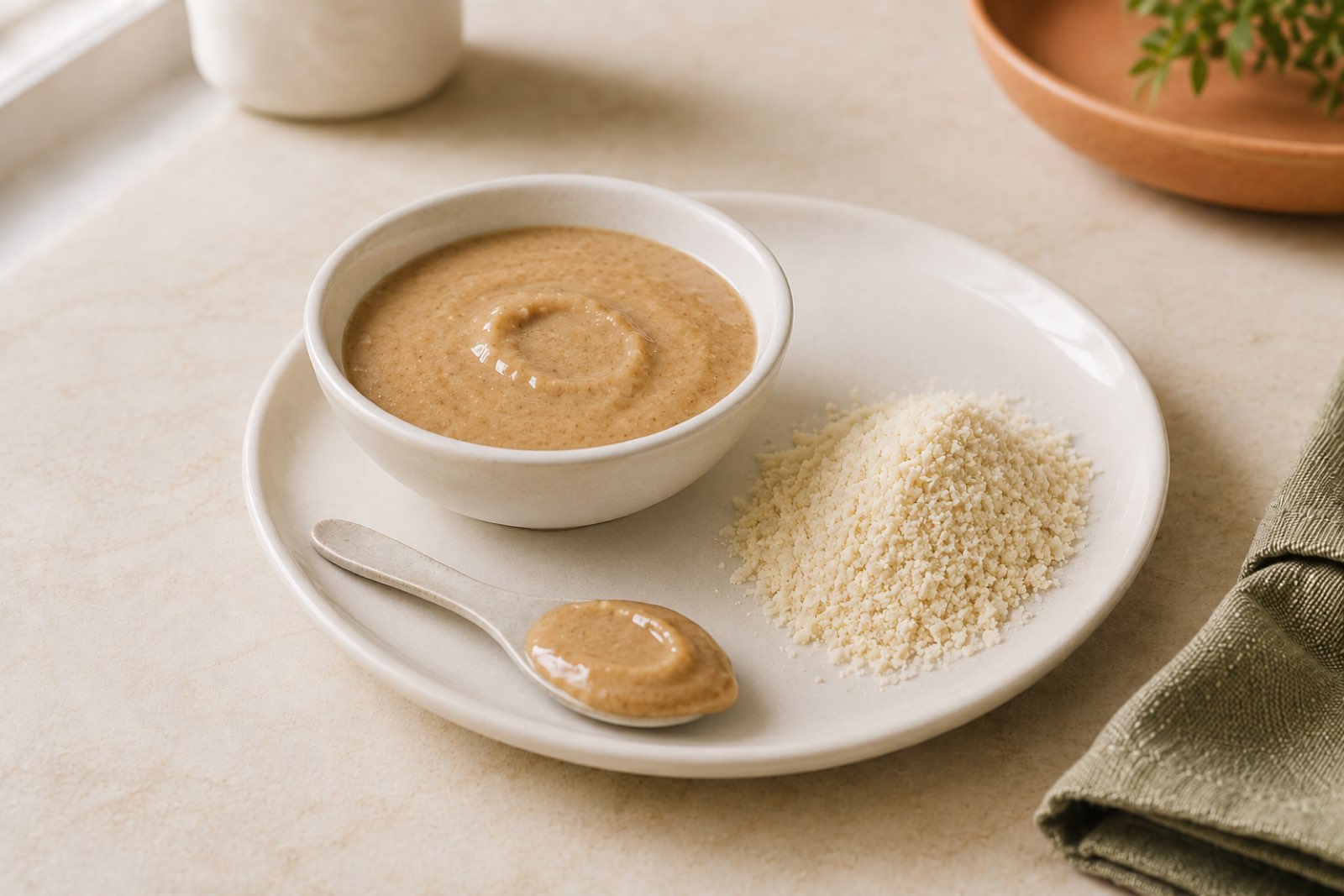
- Lower-risk forms: smooth nut butter thinned to a pourable consistency, and finely milled nut flour stirred into food. Hard nut pieces are unsafe under 4.
- A thick spoonful of nut butter is itself a choking risk. Always thin it.
- Feed with your baby seated fully upright and an adult within arm's reach.
Why Tree Nuts Carry Two Separate Risks
Most foods parents worry about carry one risk. Tree nuts carry two.
The first is allergy. Tree nuts are on the FDA's list of major food allergens, and the American College of Allergy, Asthma and Immunology (ACAAI) notes that fewer than 10 percent of people with a tree nut allergy outgrow it, unlike milk or egg allergy.
The second is choking. Nuts are hard, round, dense, and they do not dissolve, close to the worst-case shape for a small airway. A whole nut can block the airway outright, and a nut or fragment inhaled into the lungs can irritate it and lead to pneumonia.
Whole Nuts: The Age 4 Rule
Do not give a baby, toddler, or preschooler a whole tree nut.
The AAP keeps firm round foods that hold their shape under jaw pressure away from children until at least age 4, depending on chewing skill, and its choking list names nuts and seeds outright. The same rule covers whole grapes, hot dog coins, hard raw carrot coins, cheese cubes, hard candy, and popcorn.
Halving or quartering a nut does not fix it. A grape is different. Under 4, quartering it lengthwise into long strips, never coins, lowers the risk, though it does not remove it. A nut fragment is still hard, still slippery, still the wrong density at any size. Under 4, the safe change is a different form, not a smaller piece. More in choking hazards under 4 and safe cutting techniques.
Set Up Every Feeding the Same Way
Your baby eats seated fully upright in a high chair with feet supported, never reclined, lying down, crawling, walking, in a car seat, or in a moving vehicle. An adult stays within arm's reach and watching for the whole meal. Skip the food entirely if your baby is crying, drowsy, or distracted.
Take an infant and child choking first aid and CPR class before you start solids. Your pediatrician's office or local Red Cross can point you to one.
Lower-Risk Forms of Tree Nuts by Age
| Form | 6 to 12 months | 12 months to 4 years | 4 years and up |
|---|---|---|---|
| Whole, halved, or chopped nuts | No | No | Only if chewing is reliable, seated and supervised |
| Smooth nut butter, thinned | Yes | Yes | Yes |
| Thick nut butter by the spoonful | No | No | Yes, spread thin, with a drink and supervision |
| Nut butter on soft toast | No | Thin scrape only | Yes |
| Finely milled nut flour, stirred in | Yes | Yes | Yes |
| Nut milk as a drink | No | Ask your pediatrician | Yes |
Nut milks are low in the fat and protein babies need, so they do not replace breast milk, formula, or whole cow's milk in the first two years.
The Safety Search inside TinyPlate checks any nut or nut product against your child's age.
How to Thin a Nut Butter Properly
A thick spoonful of any nut butter is on the AAP's choking hazard list: it is sticky enough to form a plug. Thinning is a safety step, not a refinement.
- Start with a smooth, unsweetened nut butter, no added salt. Check the label for whole nut pieces, which some "natural" almond and cashew butters include.
- Stir about 1 teaspoon with warm water, breast milk, or formula, a little at a time, until it pours off the spoon in a thin ribbon rather than clinging in a lump. It takes more liquid than you expect.
- Or stir it into a food your baby already likes: oatmeal, yogurt, applesauce, or a vegetable puree.
Do not use honey to thin nut butter under 12 months, per AAP and CDC guidance on infant botulism.
For flours, buy commercially milled fine nut flour. Coarser "almond meal" is not the same. Home grinding of walnuts and cashews reliably leaves hard grit, so if you grind your own, take it to a powder and rub a pinch between your fingers first.
When to Introduce, by Risk Level
Delaying allergens no longer reflects the evidence, and waiting longer can raise the chance of developing an allergy. The strongest trial evidence is for peanut, in how to introduce peanut butter to your baby, and the full group is in our top 9 allergens guide.
For most babies, introduce tree nuts in a safe form around 6 months, once a few simple foods are already tolerated, and never before 4 months. Risk level changes the setting more than the window.
High risk: severe eczema, an existing egg allergy, or both. Talk to an allergist or pediatrician before the first taste. Guidance supports earlier introduction here, roughly 4 to 6 months, after that conversation. That definition comes from NIAID's 2017 peanut-specific Addendum Guidelines. No tree nut equivalent exists, so clinicians use it as a general marker. Before 6 months the form is the same: thinned smooth butter or fine flour stirred into a puree your baby already takes.
Moderate risk: mild to moderate eczema. Check in with your pediatrician, then introduce at home around 6 months.
Low risk: no eczema and no known food allergy. Introduce at home around 6 months.
Readiness beats the calendar in every tier: good head control sitting up, actively taking food from a spoon. See starting solids readiness signs.
The Introduction Itself
Pick one nut and one morning. Choose a day when your baby is well, has not had vaccines, and is not starting anything else new. Almond and cashew butters are easiest to find smooth and unsweetened.
Offer a small taste, then wait. With your baby upright in the high chair and you within arm's reach, put a dab of thinned butter on the lip or front of the tongue and wait about 10 minutes. If nothing happens, offer the rest of the teaspoon, then watch for roughly 2 hours.
Space the next nut by a few days. The AAP recommends one new single-ingredient food at a time, every 3 to 5 days. A few days makes it easier to attribute a reaction correctly.
Cashew and pistachio are botanical cousins, as are walnut and pecan, and often behave the same way in an allergic child. Introduce each as its own event, never as a mixed-nut flour.
What a Reaction Looks Like
Most reactions are mild and start within 2 hours. Per AAAAI guidance, mild signs include hives or redness around the mouth, mild lip swelling, itching, or a single episode of vomiting. Stop feeding the food immediately, watch closely, and call your pediatrician.
Mild symptoms can progress. Treat the reaction as anaphylaxis if they spread, or if you see any change in breathing, throat or tongue swelling, repeated vomiting, floppiness, pallor, widespread hives, wheezing or repetitive coughing, bluish skin, or unresponsiveness.
Give epinephrine immediately if your child has been prescribed it, then call 911. Note the time you gave it. Do not wait to see whether symptoms improve, and if you are unsure whether it is anaphylaxis, give epinephrine anyway. If symptoms continue or worsen after about 5 minutes, a second dose may be needed. Every child who receives epinephrine goes to an emergency department, even if symptoms resolve, because reactions can return hours later.
Reading Labels for Tree Nuts
US law requires manufacturers to name the specific tree nut, so "almonds" is compliant and "mixed nuts" is not. As of January 2025, the FDA considers only 12 nuts to be tree nuts for labeling purposes, and no longer treats coconut as one.
So a label may be quieter now. If your child has a confirmed tree nut allergy, read the full ingredient list, not just the "Contains" line. More in hidden allergens.
Keeping Tree Nuts in the Rotation
The step most often missed is what happens after. A first exposure gets celebrated, then the food disappears. Guidance points toward continued regular exposure, so keep each tolerated tree nut in the rotation about 2 to 3 times per week.
The Allergen Tracker in TinyPlate logs which tree nuts your child has had and flags one that has gone too long without a repeat.
The Short Version
Whole nuts stay off the plate until at least 4, no exceptions and no clever cutting. Under 4, tree nuts go in as a thinned smooth butter or a finely milled flour, always with your baby seated fully upright and an adult within arm's reach.
Introduce one nut at a time, watch for a couple of hours, then keep it coming 2 to 3 times a week.
Sources
- American Academy of Pediatrics. "When to Introduce Egg, Peanut Butter and Other Common Food Allergens to Your Baby." HealthyChildren.org.
- American Academy of Pediatrics. "Choking Prevention." HealthyChildren.org.
- American Academy of Pediatrics. "Pneumonia." HealthyChildren.org.
- Centers for Disease Control and Prevention. "Infant Botulism." CDC.gov.
- U.S. Food and Drug Administration. "Questions and Answers Regarding Food Allergens, Edition 5." January 2025.
- ACAAI. "Tree Nut Allergy." ACAAI.org.
- AAAAI. "Food Allergy Symptoms" and "Anaphylaxis." AAAAI.org.
- NIAID. "Addendum Guidelines for the Prevention of Peanut Allergy in the United States," 2017.