
How to Introduce Peanut Butter to Your Baby Safely
Key Takeaways
- Introducing peanut butter to baby between 4 and 11 months reduces the risk of developing a peanut allergy, according to the LEAP study and the NIAID's 2017 addendum guidelines.
- Whole peanuts are a choking hazard until age 4 per the AAP. Babies should never have whole peanuts. Smooth, thinned peanut butter or peanut puff snacks are the safe forms.
- High-risk infants (severe eczema or existing egg allergy) should see an allergist or pediatrician before introducing peanut at home.
- After successful introduction, regular exposure (2 to 3 times a week) helps maintain tolerance.
- Reactions, when they happen, usually appear within 2 hours. Most are mild. Severe reactions are rare but possible.
Why Early Peanut Introduction Matters
For most of the last 50 years, the standard pediatric advice was to delay peanut introduction until 2 or even 3 years old, on the theory that delay would prevent allergy. That advice has been completely overturned. The 2015 LEAP (Learning Early About Peanut Allergy) study, published in the New England Journal of Medicine, showed that introducing peanut between 4 and 11 months in high-risk infants reduced the rate of peanut allergy by approximately 81 percent compared to delayed introduction.
The 2017 NIAID addendum guidelines now recommend early peanut introduction across all infants, with specific guidance for high-risk infants to do so under medical supervision. The American Academy of Pediatrics (AAP) and AAAAI back the same approach.
This post walks through when, how, and in what form to introduce peanut butter to your baby safely, and what to watch for in case of a reaction.
Who Should Introduce Peanut at Home and Who Should See an Allergist First
The NIAID guidelines define three categories:
High-risk infants: Babies with severe eczema, an existing egg allergy, or both. These infants should see an allergist or pediatrician before peanut introduction. The doctor may recommend an in-office introduction or an allergy test (skin prick or specific IgE blood test) before introduction at home. The early introduction window is still recommended for high-risk infants. The supervised setting is what changes.
Moderate-risk infants: Babies with mild to moderate eczema. The AAP recommends introducing peanut around 6 months at home, after pediatrician check-in, with the readiness signs in place.
Low-risk infants: Babies with no eczema and no other food allergies. The AAP recommends introducing peanut at home starting around 6 months, in line with other complementary foods.
For all three categories, the AAP recommends introducing peanut in the first year, not waiting.
What Form of Peanut to Use
Whole peanuts are a choking hazard until age 4 per AAP guidance. Babies should never have whole peanuts. The safe forms are:
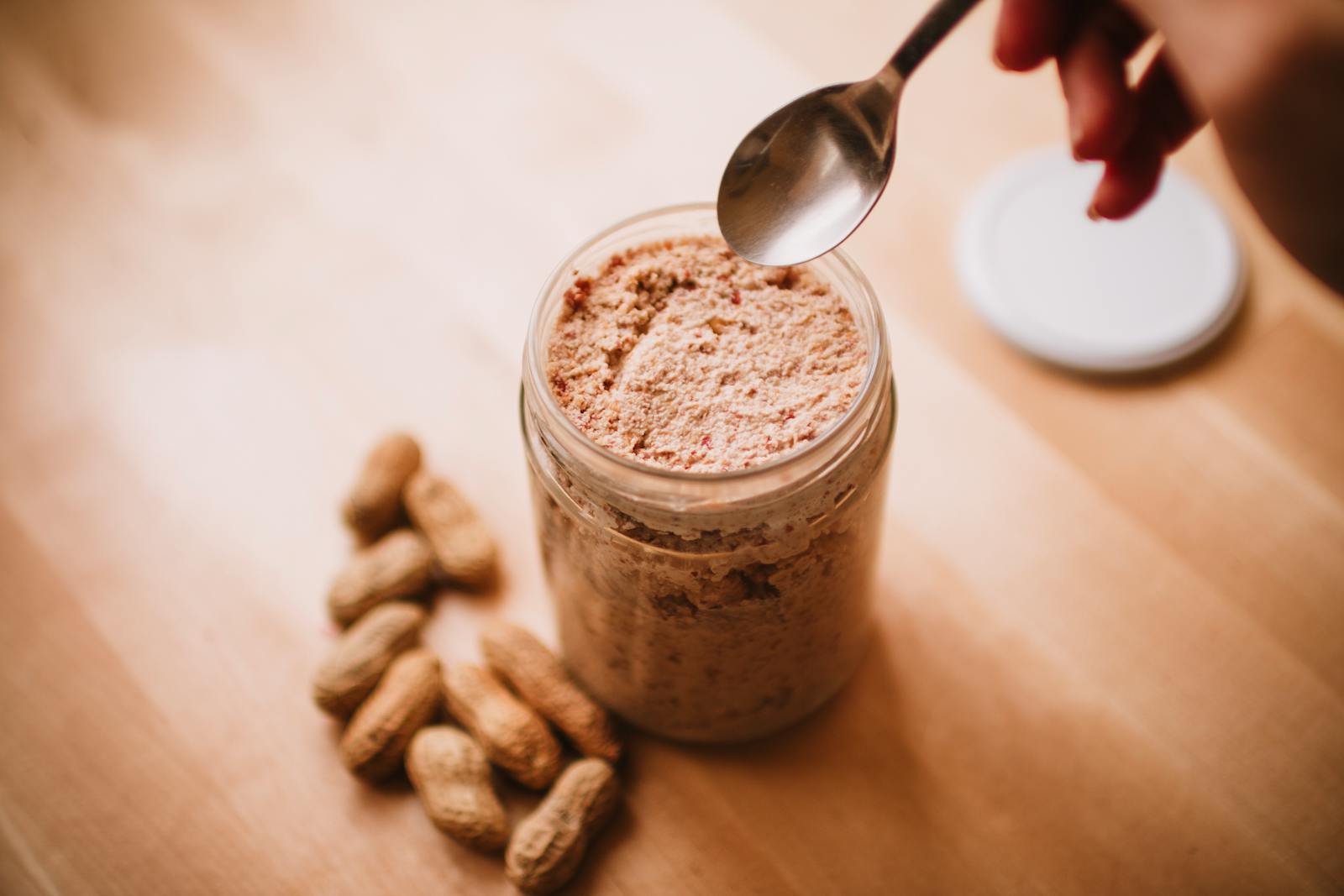
Smooth peanut butter, thinned with water or breast milk. The most common home introduction. Thin to a yogurt consistency, since unthinned peanut butter is sticky and can be a choking risk in itself.
Peanut puff snacks. Commercial puffed peanut snacks designed for babies (Bamba and similar). These dissolve quickly in the mouth and were the form used in the LEAP study.
Peanut powder. Defatted peanut powder mixed into yogurt, oatmeal, or a familiar puree. Easy to dose precisely.
Mixed into a familiar food. Smooth peanut butter stirred into oatmeal, applesauce, or yogurt. The goal is exposure to peanut protein in a form your baby can manage texturally.
Step-by-Step: A First Peanut Exposure at Home
This protocol is adapted from the NIAID guidelines and the LEAP study methodology.
Step 1: Choose a day at home. Pick a morning when your baby is well, not sick, not vaccinated that day, and not in the middle of any other new food introduction. You want a clear window of 2 to 3 hours where you can observe your baby.
Step 2: Make sure your baby has had peanut-free food before. A first peanut exposure should not be the first taste of food. Your baby should have already accepted a few non-allergenic first foods (cereal, vegetables, fruit) so they are familiar with eating from a spoon or self-feeding.
Step 3: Prepare a small amount. A first dose is typically about 1 teaspoon (5 ml) of peanut butter thinned with water or breast milk to a smooth, yogurt-like consistency. Or, mix 2 teaspoons of peanut powder into a familiar puree.
Step 4: Offer a tiny first taste. Place a small amount (about the size of a small pea, or roughly 1/8 teaspoon) on the lip or the very front of the tongue. Wait 10 minutes. Watch for any signs of reaction (redness, hives around the mouth, swelling).
Step 5: If no reaction, offer the rest gradually. Over the next 5 to 10 minutes, offer the rest of the teaspoon-sized serving in small bites. Continue watching for the next 2 hours.
Step 6: Repeat regularly. After a successful introduction, offer peanut 2 to 3 times per week as part of the rotation. The LEAP study used roughly 6 grams of peanut protein per week across multiple servings, divided into 3 or more exposures.
What an Allergic Reaction Looks Like
The AAAAI's symptom guidance for food allergic reactions in infants applies to peanut. Most reactions occur within 2 hours of exposure. Most are mild.
Mild reactions:
- Redness or hives around the mouth or face
- A few hives on the body
- Mild swelling around the mouth
- Mild itching
- One or two episodes of vomiting
Call your pediatrician for guidance. Many pediatricians refer to an allergist for evaluation if a reaction occurs. Continued exposure may or may not be advised depending on severity.
Severe reactions (anaphylaxis):
- Widespread hives
- Swelling of the lips, tongue, or throat
- Difficulty breathing, wheezing, repetitive coughing
- Vomiting combined with other symptoms
- Pale or bluish skin
- Loss of consciousness or unresponsiveness
Anaphylaxis is a medical emergency. Call 911 immediately. If your child has been prescribed epinephrine, administer it.
The AAAAI maintains a current symptom guide for parents and families.
After a Successful Introduction: Maintaining Tolerance
A common mistake after a successful peanut introduction is to forget about it. The food becomes a known quantity, and weeks or months go by without your baby eating peanut again. This is exactly the wrong move.
The LEAP-On follow-up study (published in 2016) showed that children who continued regular peanut consumption maintained their protection against allergy. Children who stopped eating peanut for a year after the LEAP intervention generally retained tolerance, but the maintenance pattern matters.
The current AAAAI guidance: continue offering peanut 2 to 3 times per week throughout childhood. This is most easily accomplished by working it into the normal weekly rotation as a snack (peanut puff snacks, peanut butter on toast for older toddlers) rather than treating it as a separate task to remember.
Foods to Avoid Mixing With a First Peanut Introduction
Two specific rules:
Do not introduce another new allergen on the same day. Space new allergens 3 to 5 days apart so you can identify the source of any reaction.
Avoid honey under 12 months. Honey is sometimes used to mix into peanut butter for older children. For babies under 12 months, honey poses a botulism risk. Use water or breast milk to thin peanut butter instead.
What TinyPlate Does Differently
Peanut is one of the top 9 allergens the Allergen Tracker inside TinyPlate manages. After a successful introduction, the tracker flags peanut for repeat exposure on the schedule the LEAP study and current pediatric guidance recommend. The AI Meal Plan then weaves peanut-containing foods into the weekly rotation automatically, so the every-week-or-two cadence is maintained without you tracking it on a paper log.
If your baby develops a confirmed peanut allergy, you can flag it in the app and every recipe from that point forward excludes peanut.
Download TinyPlate free on the App Store.
Sources
- Du Toit, G., et al. "Randomized Trial of Peanut Consumption in Infants at Risk for Peanut Allergy" (LEAP Study). New England Journal of Medicine, 2015.
- Du Toit, G., et al. "Effect of Avoidance on Peanut Allergy after Early Peanut Consumption" (LEAP-On Study). New England Journal of Medicine, 2016.
- Togias, A., et al. "Addendum Guidelines for the Prevention of Peanut Allergy in the United States." NIAID, 2017.
- American Academy of Pediatrics. "Early Introduction of Peanut Reduces Allergy Risk." HealthyChildren.org.
- American Academy of Allergy, Asthma & Immunology. "Peanut Allergy Prevention." AAAAI.org.