
How to Read a Baby Snack Label in 10 Seconds
Key Takeaways
- The front of a pouch or snack box is marketing. The three things that actually matter are allergens your child already has, honey before 12 months, and snacks that are the wrong age.
- Honey is never safe under 12 months, including in pouches, graham snacks, and "toddler" yogurts. The CDC and the American Academy of Pediatrics (AAP) warn about infant botulism.
- U.S. labels must name the top 9 allergens. Match those names to your child. For hidden names and "may contain" wording, see our hidden-allergens guide.
- Age-wrong snacks are easy to grab by mistake: popcorn, whole grapes, whole nuts, and chips meant for older kids. Solids start around 6 months, not 3. Grapes stay quartered until 4.
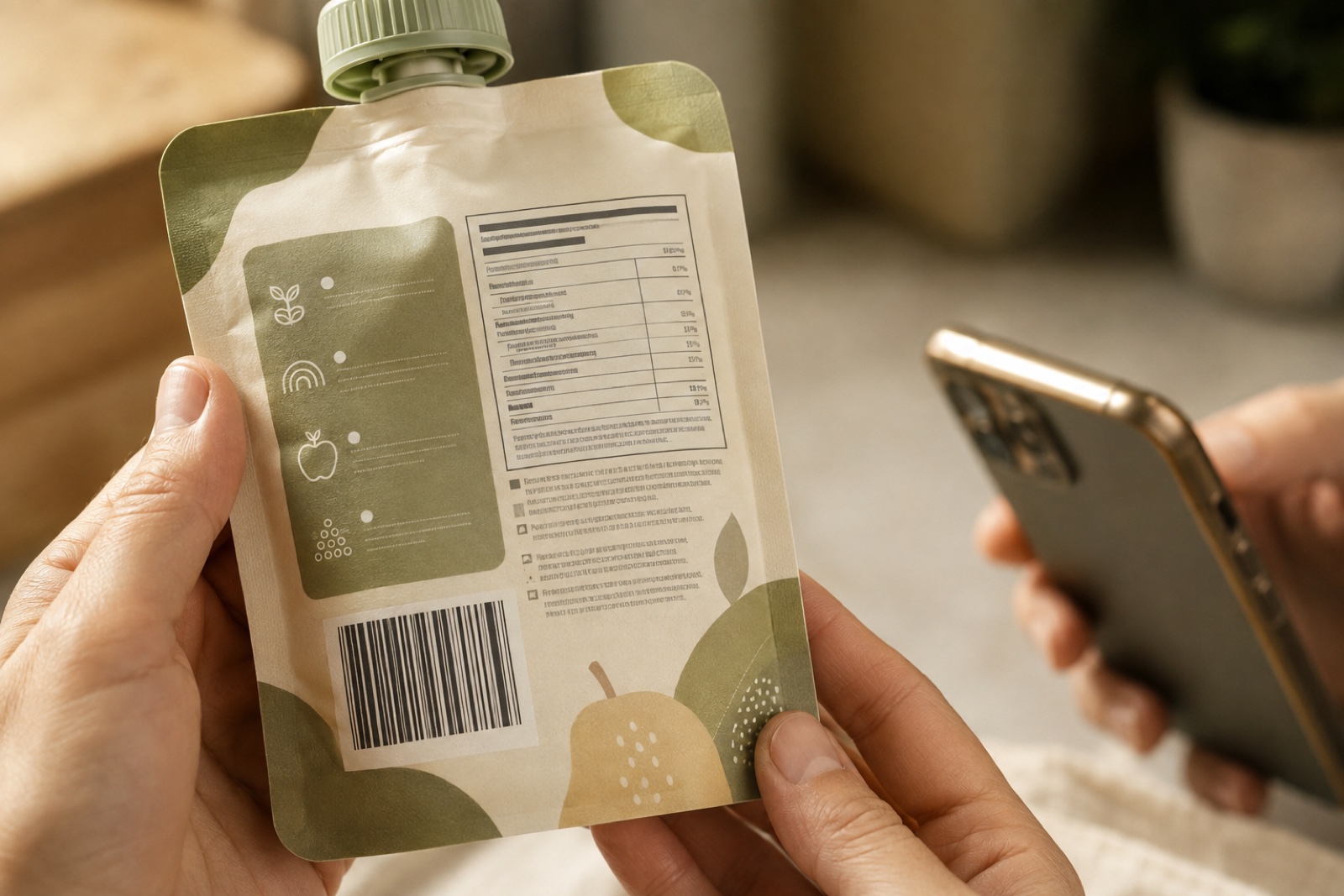
- Point the camera at the barcode. TinyPlate checks the package against your child's age and logged allergies and says whether it looks OK, needs care, or is best avoided. Loose fruit and vegetables rarely have useful barcode data. Search those by name.
Standing in the Aisle
You are holding a pouch in one hand and a snack box in the other. The front of both says "toddler," "organic," or "made for little ones." None of those words is a safety rating.
What actually matters is shorter than the label looks. Three checks catch most of the problems that show up after the box is open: allergens your child already has, honey if they are under 12 months, and snacks that are the wrong age.
Each check takes a few seconds. Together they are faster than reading the ingredient list once, and they catch more.
Three Things That Matter on the Package
Allergens Your Child Already Has
U.S. packaged foods must name the top 9 allergens in plain language: milk, egg, peanut, tree nuts, soy, wheat, fish, shellfish, and sesame. That is the Food Allergen Labeling and Consumer Protection Act, as the FDA explains it. If your child has a known allergy, the "Contains:" line is the first stop.
This is not a decoder for every hidden name. If you need that walkthrough, our guide to hidden allergens on food labels covers the patterns. Tonight you only need the names that apply to your child.
Do not wait until age 1 to introduce peanut or egg to a baby who is ready for solids. The National Institute of Allergy and Infectious Diseases (NIAID) addendum guidelines support early peanut introduction, and the AAP advises against delaying common allergens. A snack box that contains peanut is a different question if peanut is already a known allergy.
Honey Before 12 Months
Honey is never safe under 12 months. The CDC and the AAP are firm on this because of infant botulism. That includes honey in a puree pouch, a graham snack, a "toddler" yogurt, or a cereal bar. "Natural sweetness" on the front does not tell you. Flip for the word honey.
Snacks That Are the Wrong Age
"Toddler" on the box is a marketing word. It does not mean the food matches your child's chewing or airway.
A few age rules that show up constantly on packaged snacks:
- Solids start around 6 months, when your baby is ready, not at 3 months. The AAP's starting-solids window is about developmental readiness near 6 months.
- Popcorn is not a "cut it smaller" food. Pediatricians wait until at least age 4.
- Whole grapes stay a choking hazard. Quarter them lengthwise until age 4. The AAP groups firm, round foods together for a reason.
- Whole nuts belong in the same wait-until-4 group. Nut butters thinned until they drip are a different food.
- Added sugar is not recommended before age 2, per the AAP, and the 2025-2030 Dietary Guidelines for Americans say to avoid it from birth through age 4. Many snack boxes aimed at toddlers still have it.
A pouch of fruit puree can be a reasonable food once solids have started. A box of crunchy snack mix sitting next to it may not be.
Point the Camera at the Barcode
You do not have to memorize the list in the aisle.
Open TinyPlate on iPhone or Android and point the camera at the barcode on the pouch or snack box. TinyPlate checks that package against your child's age and the allergies you have logged, and shows you what the label declares. Then it tells you whether it looks OK, needs care, or is best avoided.
That is the whole move. The verdict is for this child, tonight, not a generic "toddler" age band printed on the carton.
Needs care means look closer before it goes in the cart. Best avoided means put it back.
The package in your hand is still the source of truth. Manufacturers reformulate, and a label can name an allergen in wording that does not match the way you logged it. If the verdict and the printed label disagree, trust the package and your pediatrician.
Already at Home
The same scan works in Pantry. Point the camera at a box you already bought, and add what you already have from the package.
This is useful for the half-open puff container, the yogurt pouches in the door, and the snack box a grandparent left on the counter.
When There Is No Barcode Worth Scanning
Loose fruit and vegetables rarely have useful barcode data. A sticker on a banana or a PLU code on a bag of grapes will not tell you what your child needs.
Search those by name instead. Type grape, banana, or blueberry and you get the age and cut guidance: grapes quartered until 4, bananas mashed or in a spear, blueberries smashed at the start. That check is free, needs no account, and works in the app or in a browser at tinyplate.app/safe. The safe cutting techniques guide is the long version of those cuts.
What This Comes Down To
The front of the box is trying to sell you calm. The back of the box is a long list. The useful middle is three checks, and a camera pointed at the barcode for the packaged ones.
Three checks, and a camera for the packaged ones. TinyPlate is a free download on iPhone and Android, and the food checker at tinyplate.app/safe stays free, no account needed.
Sources
- American Academy of Pediatrics. "Starting Solid Foods." HealthyChildren.org.
- American Academy of Pediatrics. "Choking Prevention." HealthyChildren.org.
- American Academy of Pediatrics. "Botulism." HealthyChildren.org.
- Centers for Disease Control and Prevention. "Botulism." CDC.gov.
- Centers for Disease Control and Prevention. "Foods and Drinks to Avoid or Limit," Infant and Toddler Nutrition.
- U.S. Food and Drug Administration. "Food Allergies: What You Need to Know." FDA.gov.
- National Institute of Allergy and Infectious Diseases. "Addendum Guidelines for the Prevention of Peanut Allergy in the United States."
- U.S. Department of Agriculture and U.S. Department of Health and Human Services. "Dietary Guidelines for Americans, 2020-2025." Added sugars before age 2.