
Summer Fruits Safe for Babies: A Guide by Age and Stage
Key Takeaways
- Most summer fruits are excellent first foods, but cut size is the difference between safe and a choking hazard.
- Whole blueberries, whole grapes, and cherry tomatoes are among the top choking hazards for children under 4, per AAP guidance.
- Stone fruits (peaches, plums, nectarines, cherries) need careful pit removal and skin softening for young babies.
- Watermelon and melon are some of the easiest first fruits at 6 months, with the rind always removed.
- Frozen fruit can soothe teething gums, but only when offered in a safe form (mesh feeder or frozen as a bar, not whole chunks).
Summer Fruits for Babies, the Right Way
Summer is when fruit shows up in volume. Watermelon at every cookout, berries by the pint, peaches that taste like the sun. Most summer fruits are excellent for babies. The hazard is not the fruit, it is the cut. A grape that is safe for an adult is a choking hazard for a 9-month-old until it is quartered. A blueberry that an adult swallows without thinking is among the foods most often linked to choking incidents in young children, per the American Academy of Pediatrics.
This is a stage-by-stage guide to the most common summer fruits, with the cutting and preparation guidance pediatricians actually use.
Watermelon
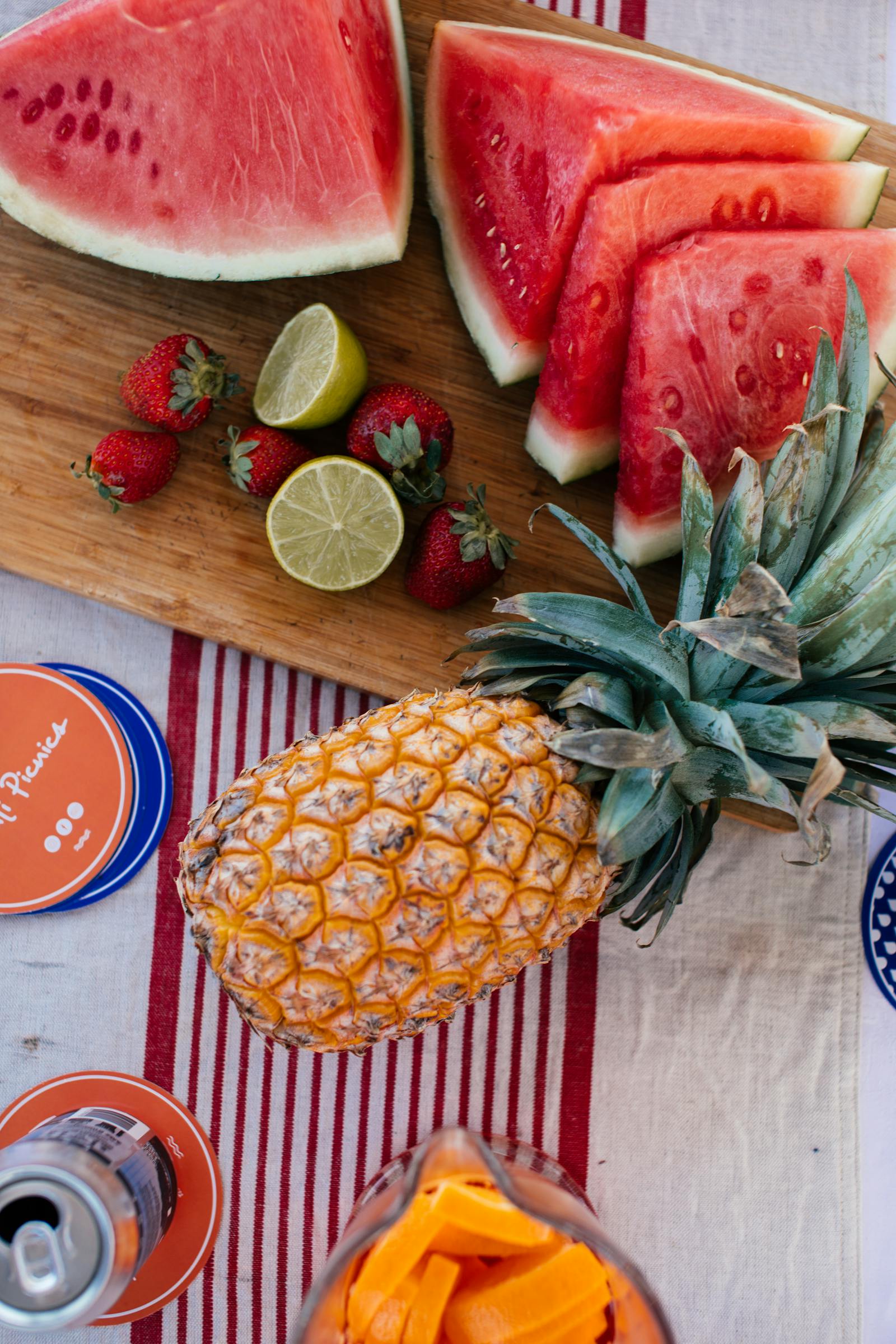
Watermelon is one of the friendliest first fruits. Soft, sweet, juicy, and easy to prepare.
6 to 8 months: Cut the watermelon into long, thin spears (about the length of your finger, narrow enough to grip). Skin and rind always removed. Soft, ripe fruit only. A young baby will gum the spear and get juice and small soft pieces, which is fine.
9 to 11 months: Smaller cubes (about pea-sized) work once your baby has a pincer grasp. Watch for seeds and remove them. Seedless watermelon is easiest.
12 months and up: Small bite-sized pieces. Always remove rind.
Hazard note: Watermelon rind is firm and stringy, a choking hazard. Always remove. Black seeds are also a hazard for young babies, remove or choose seedless.
Berries: Strawberries, Blueberries, Blackberries, Raspberries
Berries are nutrient-dense (vitamin C, fiber, antioxidants) but berry size and skin texture matter.
Blueberries:
- 6 to 8 months: Smashed or quartered. Never whole. A whole blueberry is one of the foods the AAP names as a leading choking hazard for children under 4.
- 9 to 11 months: Halved lengthwise (creates an oval, not a sphere).
- 12 months to 4 years: Keep blueberries halved or quartered through the toddler years unless this child chews well. Grapes and cherry tomatoes stay quartered lengthwise through age 4.
Strawberries:
- 6 to 8 months: Hulled and cut into thin slices, or mashed with a fork. Ripe strawberries are very soft and easy.
- 9 to 11 months: Small dice (pea-sized).
- 12 months and up: Small bite-sized pieces.
Blackberries and raspberries:
- 6 to 8 months: Mashed. The small seeds are not a hazard but the cluster shape can be hard to manage whole.
- 9 to 11 months: Halved, especially blackberries.
- 12 months and up: Whole if very soft and ripe. Some toddlers still find blackberries large; halve if in doubt.
Stone Fruits: Peaches, Plums, Nectarines, Cherries
Stone fruits are a summer staple, with one specific safety consideration: the pit.
Peaches and nectarines:
- 6 to 8 months: Peel (skin can be tough for young babies), slice the flesh into soft strips or mash. Pit must be removed completely.
- 9 to 11 months: Small soft pieces of peeled fruit. Peel can remain if very ripe and soft.
- 12 months and up: Bite-sized pieces. Always remove pit.
Plums:
- 6 to 8 months: Peeled and mashed, or in very thin slices. Plums are a known mild laxative due to sorbitol content, useful if your baby is constipated, less useful otherwise.
- 9 to 11 months: Small pieces of peeled fruit.
- 12 months and up: Small bite-sized pieces, pit removed.
Cherries:
- 6 to 8 months: Pitted, peeled, and mashed or in very small soft pieces.
- 9 to 11 months: Pitted and halved or quartered. A whole cherry, even pitted, is a choking risk for young babies due to size and skin.
- 12 months to 4 years: Pitted and quartered lengthwise through age 4. A cherry is round and firm, the same shape risk as a grape, so halving is not enough.
Mango
Mango is a sweet, soft, nutritionally dense fruit and a strong first food.
6 to 8 months: Long spears of ripe peeled mango. The texture is soft enough for a young baby to gum.
9 to 11 months: Small dice of peeled, ripe mango.
12 months and up: Bite-sized pieces.
Hazard note: Unripe mango is firm and stringy. Use only ripe fruit. Skin should always be removed.
Grapes
Grapes are one of the most common choking incidents in young children, and the rule is simple: quartered lengthwise through age 4.
6 to 8 months: Most pediatricians recommend waiting until at least 9 months for grapes, and offering only quartered. Some families wait until 12 months for grapes specifically.
9 to 11 months: Always quartered lengthwise. Never whole, never halved. Lengthwise quarters create thin slivers that cannot block an airway.
12 months to 4 years: Quartered through age 4 per AAP guidance.
The AAP includes grapes in its list of top choking hazards alongside hot dogs and whole nuts. Cut every time, every grape.
Pineapple
Pineapple is acidic and can cause mouth irritation in young babies. Most pediatricians recommend waiting until 8 to 9 months and starting with very small amounts.
8 to 11 months: Fresh, ripe pineapple cut into thin small pieces. Avoid canned pineapple in syrup.
12 months and up: Bite-sized pieces.
Hazard note: Pineapple skin and core are tough and must be fully removed.
Frozen Fruit and Teething
Frozen fruit can soothe teething, but only in safe form:
- A mesh feeder (a small bag-like baby tool) holds small frozen pieces safely. The baby can gnaw and get small amounts of fruit and juice without a choking risk.
- A homemade fruit pop frozen on a baby-safe handle works for older babies (9 months and up).
- Whole frozen blueberries, grape halves, or cherry pieces are not safe even when frozen. The hardness adds a hazard.
A Note on Sugar and Juice
Whole fruit is the best form of fruit for babies and toddlers. The AAP and the World Health Organization both recommend no fruit juice for babies under 12 months, and at most 4 ounces a day of 100 percent fruit juice for toddlers 1 to 3 years. Juice removes the fiber and concentrates the sugar, which is the opposite of what young children need. Pureed fruit (smoothies made at home, not store-bought) is closer to whole fruit but still falls short, since the act of chewing whole fruit helps satiate and slows sugar absorption.
What TinyPlate Does Differently
The Safety Search inside TinyPlate is the fastest way to check any specific fruit and any specific cut for your child's age. Search "blueberries" and you get clear cut-size guidance for 6 months, 9 months, 12 months, and 4 years. The Weekly Meal Plan rotates seasonal fruits into the plan automatically when summer is in season, so you do not have to think about variety. Recipes flagged "summer" pull from the fruits that are at peak right now.
Download TinyPlate free on the App Store.
Sources
- American Academy of Pediatrics. "Choking Prevention." HealthyChildren.org, 2023.
- American Academy of Pediatrics. "Fruit Juice and Your Child's Diet." HealthyChildren.org.
- Centers for Disease Control and Prevention. "Foods and Drinks for 6 to 24 Month Olds." CDC Infant and Toddler Nutrition.
- U.S. Department of Agriculture. "Dietary Guidelines for Americans, Birth to 24 Months." USDA, 2020 to 2025.
- World Health Organization. "Infant and Young Child Feeding." WHO Fact Sheet.